Which Sales Tax Do You Charge an Out-of-Province Client? Canada’s Place-of-Supply Rules Explained
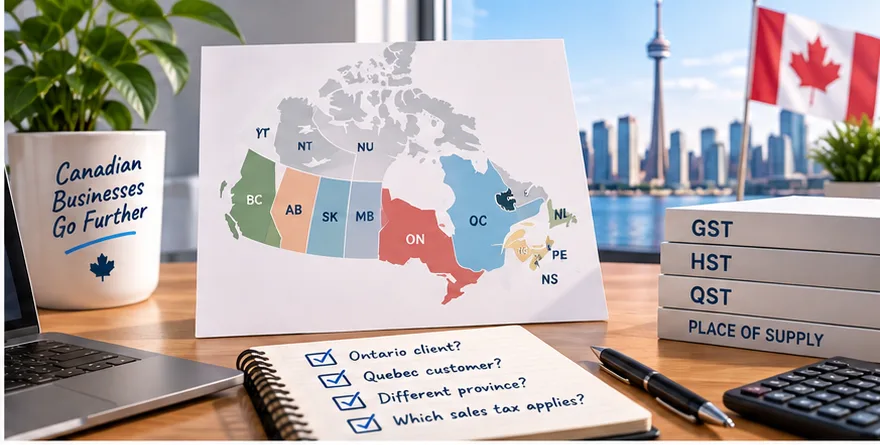
You're in Alberta and your customer is in Ontario.
Do you charge Alberta's 5% GST — or Ontario's 13% HST?
Or perhaps you're an Ontario consultant invoicing a Quebec company. Does your invoice get Ontario HST, or GST and QST?
Once a Canadian business begins selling outside its home province, sales tax stops being quite as simple as “use the rate where my business is located.”
The missing concept is place of supply.
Canada's place-of-supply rules determine which province a taxable transaction is considered to take place in. That province can determine whether the invoice carries GST, HST, or, in Quebec, GST and QST.
For many ordinary services, the result follows the customer's relevant Canadian address rather than the supplier's location.
The quick version
For many professional services, if you obtain your customer's Canadian business or home address in the normal course of business, that address will generally determine the province of supply.
For example:
| Supplier | Customer | Typical tax on an ordinary service |
|---|---|---|
| Alberta | Ontario | HST 13% |
| Ontario | Alberta | GST 5% |
| Ontario | Quebec | GST 5% + QST 9.975% |
| Quebec | Ontario | HST 13% |
| BC | Nova Scotia | HST 14% |
| Quebec | Quebec | GST 5% + QST 9.975% |
That's the useful shortcut.
But it is only a shortcut.
Different rules can apply to goods, real-property services, services related to physical property, transportation, telecommunications, computer-related services, and other specific supplies.
And BC, Saskatchewan, and Manitoba have separate provincial sales-tax regimes that may need to be considered independently.
Example 1 — An Alberta consultant invoices an Ontario company
Suppose a consultant in Calgary provides strategy services to a business in Toronto.
The consultant performs all of the work from Alberta but obtains the customer's Ontario business address in the ordinary course of business.
For an ordinary service governed by the general rule, the place of supply is Ontario.
A $2,000 invoice would generally look like this:
| Line | Amount |
|---|---|
| Consulting services | $2,000.00 |
| HST — Ontario (13%) | $260.00 |
| Total | $2,260.00 |
The supplier's Alberta location does not turn the transaction into a 5% GST sale.
For this service, the customer's Ontario address determines the place of supply.
Example 2 — An Ontario consultant invoices an Alberta client
Now reverse the situation.
A Toronto consultant provides the same type of service to a Calgary company and obtains its Alberta business address.
The place of supply is generally Alberta, a non-participating province.
The invoice on $2,000 would therefore show:
| Line | Amount |
|---|---|
| Consulting services | $2,000.00 |
| GST (5%) | $100.00 |
| Total | $2,100.00 |
No Ontario HST is charged merely because the supplier happens to work in Toronto.
Example 3 — An Ontario company invoices a Quebec customer
Quebec makes the issue slightly more interesting because it operates its own QST alongside the federal GST.
Suppose an Ontario Web designer creates a site for a company in Montreal and obtains only the customer's Quebec business address.
Revenu Québec specifically uses this kind of example in its place-of-supply guidance.
Even though the supplier performs the work in Ontario, the customer's Quebec address makes the place of supply Quebec.
For GST/HST purposes, that means Ontario HST doesn't apply — the supplier charges 5% GST.
QST is a different question. It's a separate Quebec registration, and an Ontario business that doesn't carry on business in Quebec generally isn't required to register for it when it sells to other businesses. In the typical case, the invoice therefore shows GST 5% only.
That changes if the supplier carries on business in Quebec, or sells to Quebec consumers and exceeds the thresholds of Quebec's specified-supplier registration system. In that case, QST at 9.975% is added.
The reverse also works: a Quebec business supplying an ordinary service to an Ontario customer generally charges Ontario HST rather than GST + QST.
Example 4 — A BC agency invoices a Nova Scotia business
A Vancouver marketing agency works remotely for a company in Halifax.
It obtains the customer's Nova Scotia business address.
For an ordinary service under the general rule, the place of supply is Nova Scotia.
Nova Scotia's HST rate has been 14% since April 1, 2025.
So on a $1,000 invoice:
| Line | Amount |
|---|---|
| Marketing services | $1,000.00 |
| HST — Nova Scotia (14%) | $140.00 |
| Total | $1,140.00 |
Again, the tax isn't based simply on where the agency's office is located.
Why the customer's address matters
The CRA's general rule for many services starts with information the supplier obtains in the ordinary course of business.
If you obtain only one Canadian home or business address for your customer, that address generally determines the province of supply.
If you have multiple addresses, you generally look for the address most closely connected with the service.
That's one practical reason your client record should contain more than a name and email address.
A complete business address can affect your tax treatment.
What if you don't obtain the customer's address?
Then the rules become less convenient.
When no Canadian address is obtained, the place-of-supply analysis can depend on where the Canadian portion of the service is actually performed.
For example, if the service is not performed primarily in participating HST provinces, the supply may be considered made in a non-participating province and subject to GST rather than HST.
That complexity is another good reason to collect proper billing information when onboarding a client.
Services related to real estate are different
The customer's office address does not override every other rule.
Suppose a Quebec painting company is hired by an Ontario corporation to paint a warehouse located in Ontario.
The service relates directly to real property.
The property is in Ontario, so the place of supply is Ontario and Ontario HST generally applies.
The CRA uses this exact fact pattern in its current place-of-supply guidance.
The location of the building matters more than the supplier's office or the customer's corporate headquarters.
Goods generally follow delivery
Physical goods use different rules from ordinary consulting services.
When a supplier delivers or ships goods to the customer, the province where the goods are delivered will generally determine the place of supply for GST/HST purposes.
A business in Alberta that ships a product to a customer in Ontario will generally charge Ontario HST.
If that same Ontario customer physically takes delivery of the product in Alberta, the answer can differ.
So for goods, don't automatically apply the billing-address rule you use for services.
Look at the delivery arrangement.
GST/HST isn't the whole Canadian sales-tax system
This is where Canadian sales tax becomes more complicated than a simple national rate table.
The federal place-of-supply rules tell you whether GST or a participating province's HST applies.
Quebec also uses place-of-supply rules to determine whether QST applies.
But British Columbia, Saskatchewan, and Manitoba operate separate provincial sales-tax systems.
Depending on what you sell — particularly goods, software, digital products, telecommunications, or other specifically taxable supplies — you may have additional provincial obligations.
So an invoice to a BC customer that correctly carries 5% GST is not automatically proof that you've handled every possible BC sales-tax obligation.
For straightforward professional services, that distinction often doesn't change the invoice.
For software companies, retailers, and businesses shipping products nationwide, it can matter a great deal.
Do you need a separate HST registration for each province?
No.
GST and HST are part of the same federal registration system.
If you're registered for GST/HST, you don't get a new tax number because you acquired an Ontario or Nova Scotia customer.
You continue using your GST/HST registration number and apply the rate appropriate to the taxable supply.
Quebec's QST is a separate regime, although businesses operating in Quebec generally deal with Revenu Québec for both GST/HST and QST administration.
What if you're still a small supplier?
Place of supply tells you which tax regime applies to the transaction.
It does not by itself mean an unregistered small supplier suddenly needs to add HST to an invoice.
If you're below Canada's small-supplier threshold and haven't voluntarily registered, the usual registration rules still matter.
Before charging GST/HST, make sure you're actually registered or required to be registered.
For the registration side of the equation, see our guide to Canada's $30,000 GST/HST small-supplier rule.
A practical pre-invoice check
When billing an out-of-province customer, start with four questions.
What am I selling?
A normal professional service, physical product, service related to a building, software subscription, freight service, or something else?
What customer address do I have?
For many ordinary services, this is the most important piece of information.
Does a specific place-of-supply rule override the general service rule?
Real property and goods are two common examples where different rules apply.
Are there separate provincial tax rules to consider?
This matters particularly in provinces with stand-alone sales taxes.
How InvoiceCast handles multi-province invoicing
InvoiceCast includes current Canadian sales tax formulas covering GST, HST, QST, and provincial tax combinations.
That means a business can invoice an Alberta customer using GST, an Ontario customer using HST, and a Quebec customer using separate GST and QST lines without rebuilding the invoice calculation each time.
You choose the tax treatment appropriate to the transaction, and InvoiceCast calculates and displays the selected taxes.
The distinction matters:
Good invoicing software can apply the tax rule you select. It should not pretend that software can determine every place-of-supply question from a postal code alone.
Your business still needs to determine what it is selling and which rules apply.
The bottom line
If you sell only within your own province, it's easy to assume your home-province rate is simply “your tax rate.”
Once you begin serving customers across Canada, that assumption breaks down.
For many ordinary services, the customer's relevant Canadian address determines the province of supply.
That can mean:
Alberta → Ontario: 13% HST
Ontario → Alberta: 5% GST
Ontario → Quebec: GST + QST
Quebec → Nova Scotia: 14% HST
But goods, real-property services, and other specific supplies can follow different rules, while separate provincial sales taxes may create additional obligations.
The useful question isn't:
“What sales tax does my province charge?”
It's:
“Where is this particular supply considered to have been made?”
----
Sources: