Input Tax Credits: How to Recover the GST/HST You Pay on Business Expenses
The half of the equation nobody talks about
Most guidance about GST/HST registration focuses on one side of the ledger: the tax you have to start charging your clients. It's framed as a burden — a new line on your invoice, a new obligation, a new deadline.
That's half the picture, and it's the less interesting half.
The other half is that once you're registered, the GST/HST you pay on your own business purchases stops being a cost. You get it back. That mechanism is called an input tax credit, and it changes the arithmetic of registration enough that a lot of businesses under the threshold should be registering voluntarily — and a lot of registered businesses are leaving real money unclaimed.
What an input tax credit actually is
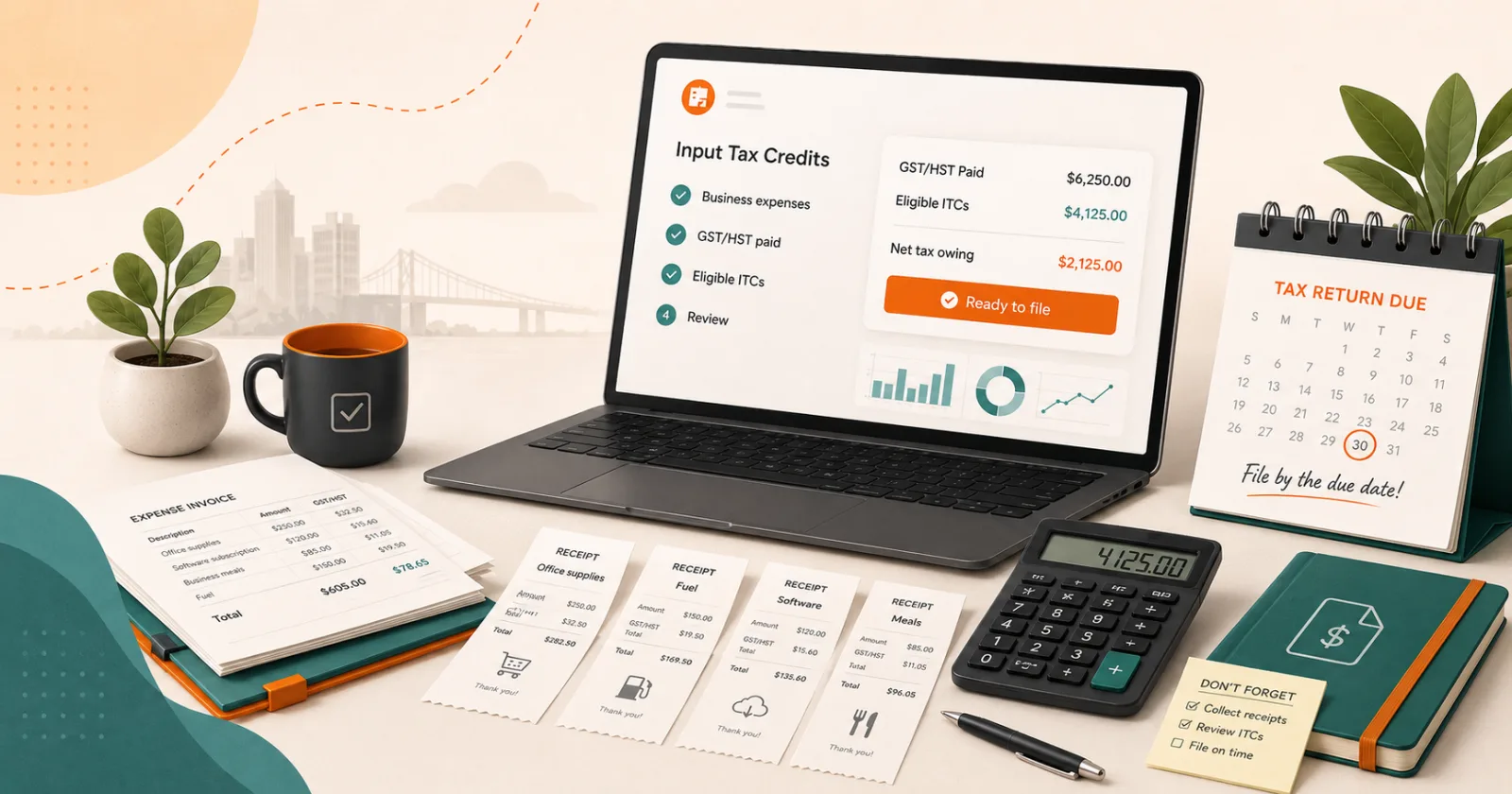
As a GST/HST registrant, you recover the tax you paid or owe on purchases and expenses related to your commercial activities by claiming input tax credits — ITCs — in your return.
Mechanically it's a subtraction. At the end of each reporting period:
GST/HST collected on your sales − ITCs on your purchases = net tax you remit
If your ITCs exceed what you collected, the result is negative and you're owed a refund. That's a common position for a business in a heavy investment period — buying equipment, stocking inventory, paying professional fees to get started.
The credit only runs to the extent your purchases relate to commercial activity. Buy something used entirely for the business, and generally you claim the full GST/HST paid on it. Buy something used partly for personal purposes, and you claim the business portion. Where a purchase is used 90% or more in commercial activities, you're generally entitled to claim it in full.
Why this is the real argument for registering early
Here's what makes ITCs strategically interesting rather than merely administrative.
Below $30,000 in worldwide taxable revenue over four consecutive calendar quarters — or in a single quarter — you're a small supplier and registration is optional. Our guide to the $30,000 rule covers the thresholds and the 29-day deadline in detail.
The instinct is to stay unregistered as long as possible. Less paperwork, and your prices look lower to consumers.
But an unregistered small supplier doesn't charge GST/HST and doesn't recover it either. Every dollar of tax you pay on your laptop, your software subscriptions, your accountant, your equipment — that's a permanent cost.
So the voluntary registration question comes down to two things:
Who are your clients? If you sell to registered businesses, the tax you charge them costs them nothing — they claim it back as their own ITC. Charging GST/HST to a B2B client is close to price-neutral from their side. If you sell to consumers, your tax-inclusive price genuinely goes up, and that's a real competitive consideration.
What are you spending? If you have meaningful start-up or equipment costs, registering early to recover the tax on them can be worth considerably more than the compliance cost.
For most B2B freelancers and consultants, those two answers point the same way. There's also a softer point that's true even if unquantifiable: business clients notice when a supplier isn't registered, and some read it as a signal about size.
One piece of relief worth knowing: if you were a small supplier before registering, you can generally claim ITCs on certain property you held at the time of registration — capital property and inventory are the usual examples. Registering doesn't necessarily forfeit everything you bought beforehand.
Three tax systems, three different answers
This is where a Canada-wide picture diverges from a Quebec-only one, and where a lot of cross-province confusion starts.
HST provinces — Ontario, New Brunswick, Nova Scotia, Prince Edward Island, Newfoundland and Labrador. A single harmonized tax. You recover the whole thing as an ITC, provincial portion included.
GST-only provinces with a separate PST — British Columbia, Saskatchewan, Manitoba. Here's the trap: you recover the 5% GST as an ITC, but provincial sales tax generally isn't recoverable at all. BC PST, Saskatchewan PST and Manitoba RST have no input-credit mechanism equivalent to ITCs. There are exemptions — most notably for goods bought for resale — but as a general rule, PST you pay on business inputs is a real, permanent cost that never comes back.
That distinction matters when you're comparing a supplier quote in Vancouver against one in Toronto. The Ontario quote's 13% is fully recoverable; the BC quote's 7% PST portion isn't. Same headline rate range, different actual cost.
Alberta and the territories — 5% GST only, fully recoverable, no provincial layer.
Quebec — two taxes, one administrator. You recover the 5% GST through ITCs and the 9.975% QST through the parallel provincial mechanism, the input tax refund (ITR). Revenu Québec administers both regimes, so a Quebec registrant files a single combined return covering the pair. The QST is genuinely recoverable in a way that BC or Saskatchewan PST is not — which is a meaningful and underappreciated advantage of the Quebec system, whatever else you think of running two tax lines.
What qualifies
Common expenses that generally support an ITC claim:
- business start-up costs
- accounting, legal and other professional fees
- office supplies, software and subscriptions
- equipment, tools and capital property
- rent on commercial premises
- maintenance and repairs
- fuel and oil
- delivery and freight charges
- business use of home, to the extent it qualifies
- advertising and marketing
What doesn't
Just as important, and where the errors cluster:
Purchases for exempt supplies. Making exempt supplies isn't commercial activity. Long-term residential rent is the standard example — the GST/HST you pay on inputs to an exempt activity isn't recoverable.
Anything personal. No ITC on the personal portion of a mixed-use purchase, and none at all on purchases made for personal purposes.
Recreational club memberships. Sports clubs, golf clubs, hunting and fishing clubs — the membership itself doesn't support an ITC.
Meals and entertainment, past 50%. These are generally 50% deductible, so only half the GST/HST paid supports a credit. There's more than one accepted method for applying the restriction across a fiscal year; pick one and be consistent.
Passenger vehicles and aircraft below the commercial-use threshold. Specific restrictions apply where an individual or partnership uses them less than 90% in commercial activities.
Anything under the Quick Method. If you've elected the Quick Method of accounting, you generally can't claim ITCs on most operating purchases — that trade-off is the whole design of the method. It suits some businesses and is a straightforward loss for others, particularly anyone with significant taxable inputs. Model it before electing.
Four rules that catch people out
1. You must have been a registrant when the tax was paid. ITCs are available for the period in which you were registered. Timing your registration matters more than people assume.
2. No documentation, no credit. This is the one that costs real money in an audit. A legitimate business expense without adequate supporting documentation is not a recoverable one. Keep supplier invoices showing the tax charged and the supplier's registration number. A credit card statement showing an amount is not sufficient evidence of the tax paid.
3. You have four years — but don't use them. Generally, you can claim an ITC up to the due date of the return for the period ending four years after the end of the reporting period in which the purchase was made. That's a useful backstop if you find something you missed. It's a terrible operating plan, because recovering a year of scattered receipts costs more in time than the credits are worth.
4. There's a simplified calculation method. Rather than tracking tax on each purchase individually, you can elect to apply a tax fraction to your total taxable purchases — 5/105 in the GST regime, with the equivalent provincial fraction in Quebec. It reduces line-by-line tracking, requires an election, and comes with its own list of exclusions. Worth discussing with your accountant rather than adopting from a blog post.
The unglamorous part that determines the outcome
Every rule above collapses into one operational question: at the end of your reporting period, can you produce the total GST/HST you paid on business purchases, backed by documents?
If yes, claiming ITCs takes minutes. If no, you either spend a weekend reconstructing it or you under-claim — and under-claiming is silent. Nobody sends you a notice saying you left credits on the table.
Capturing expenses as they happen, with the tax broken out and the receipt attached, is the entire discipline. InvoiceCast records expenses with their tax breakdown alongside the invoices you issue, so both halves of the net tax calculation live in the same place.
For a quick check on any single amount, the sales tax calculator breaks a subtotal into its GST, HST, QST or PST components — or works backward from a total to show you the tax you actually paid.
Rules change and situations differ. The CRA's page on input tax credits is the federal authority, and Revenu Québec's guidance on ITCs and ITRs covers the Quebec pair. For anything close to the line, ask your accountant.
Both halves in one place. Issue invoices with the right tax lines, record expenses with the tax broken out, and arrive at your filing period with the numbers already there. Get started free →