How to Calculate and Charge GST, HST, and QST on Your Invoices
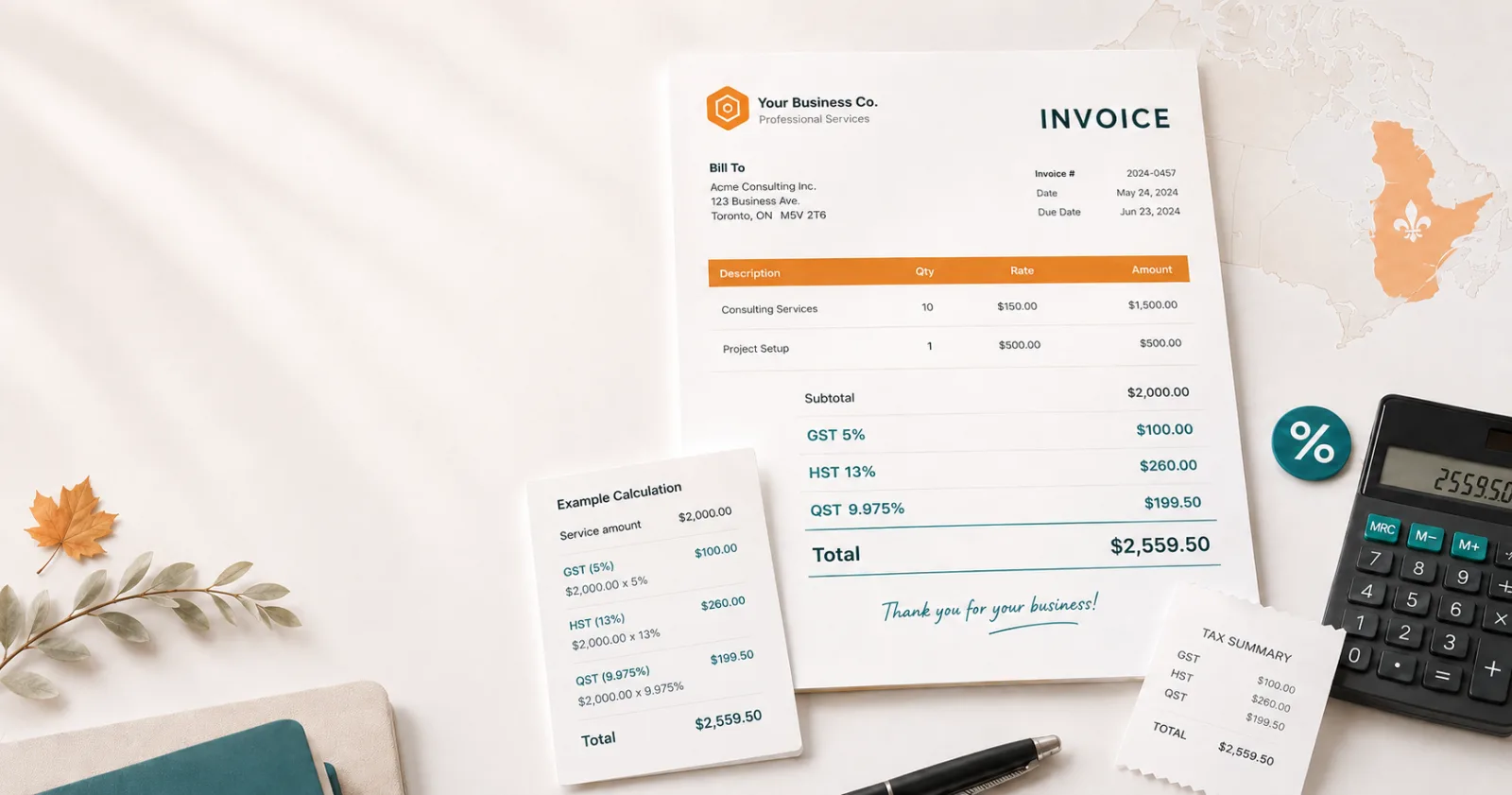
Canada doesn't have one sales tax — it has three systems, and which one lands on your invoice depends on where your customer is, not where you are. Some provinces charge a single harmonized tax (HST), Quebec charges two taxes on separate lines (GST + QST), and a few provinces layer a separate provincial tax on top of the federal GST.
Most invoicing mistakes we see from Canadian freelancers and small businesses come down to applying the wrong system: an "HST" line on an invoice to a Quebec client, a combined rate where two separate lines are required, or tax charged by someone who isn't registered to charge it. This guide walks through which tax applies where, how to calculate each one, and how to present them correctly on a compliant invoice.
Which tax applies where (2026 rates)
The federal GST is 5% everywhere in Canada and hasn't changed since 2008. What varies is the provincial layer:
| Province / territory | System | Rate(s) | Total |
|---|---|---|---|
| Ontario | HST | 13% | 13% |
| Nova Scotia | HST | 14%* | 14% |
| New Brunswick, Newfoundland and Labrador, PEI | HST | 15% | 15% |
| Quebec | GST + QST | 5% + 9.975% | 14.975% |
| British Columbia | GST + PST | 5% + 7% | 12% |
| Manitoba | GST + RST | 5% + 7% | 12% |
| Saskatchewan | GST + PST | 5% + 6% | 11% |
| Alberta, NT, NU, YT | GST only | 5% | 5% |
* Nova Scotia reduced its HST from 15% to 14% on April 1, 2025. If you invoice Nova Scotia clients and your templates still say 15%, update them.
Three things to take from this table:
- In HST provinces, the invoice shows a single HST line at the combined rate. You don't break out the federal and provincial portions.
- In Quebec, the invoice shows two lines — GST (5%) and QST (9.975%) — never a single "HST" line. Quebec is not a participating HST province.
- In GST + PST provinces, GST goes to the CRA and PST is a separate provincial regime with its own registration rules. This guide focuses on GST/HST and QST; if you sell taxable goods into BC, Saskatchewan, or Manitoba, check that province's PST rules separately.
Place of supply: the customer's location sets the rate
For most services, the rate is determined by the place of supply — generally where your customer is, typically their business address for B2B services. A Toronto consultant invoicing a Montreal client charges GST + QST, not Ontario HST. A Montreal developer invoicing a Halifax client charges 14% HST, not GST + QST.
This is the single most common surprise for service businesses that start selling outside their home province: your own address doesn't decide the tax — your client's does. (There are special rules for goods, digital products, and mobile services; when in doubt, the CRA's place-of-supply guidance is the authority.)
How to calculate each tax
All of these are calculated on the pre-tax amount. In Quebec, GST and QST are each calculated independently on the pre-tax subtotal — since 2013, QST is no longer applied on top of GST. There's no "tax on tax."
HST province (single line):
- HST = subtotal × provincial rate (13%, 14%, or 15%)
Quebec (two lines):
- GST = subtotal × 5%
- QST = subtotal × 9.975%
Example 1 — $1,000 of services to an Ontario client
| Line | Amount |
|---|---|
| Subtotal | $1,000.00 |
| HST (13%) | $130.00 |
| Total due | $1,130.00 |
Example 2 — $1,000 of services to a Quebec client
| Line | Amount |
|---|---|
| Subtotal | $1,000.00 |
| GST (5%) | $50.00 |
| QST (9.975%) | $99.75 |
| Total due | $1,149.75 |
Example 3 — a contractor invoicing $3,500 to a Quebec business
| Line | Amount |
|---|---|
| Subtotal | $3,500.00 |
| GST (5%) | $175.00 |
| QST (9.975%) | $349.13 |
| Total due | $4,024.13 |
The contractor then remits the collected tax on their filing schedule (monthly, quarterly, or annually) — GST/HST to the CRA, or both taxes to Revenu Québec if the place of supply is Quebec.
Reverse calculation: finding the pre-tax amount from a total
Useful for expense reports or a tax-included receipt. Divide the total by 1 plus the combined rate:
- Ontario: $1,130.00 ÷ 1.13 = $1,000.00
- Quebec: $1,149.75 ÷ 1.14975 = $1,000.00, then GST = $50.00 and QST = $99.75
Prefer not to do this by hand? Our free Sales Tax Calculator handles GST, HST, QST, and PST in both directions — no sign-up.
Rounding and how the taxes appear on the invoice
- Each tax line rounds to the nearest cent ($0.005 and up rounds up).
- In Quebec, show GST (5%) and QST (9.975%) as two separate lines, each with its dollar amount. Don't show a single combined "14.975%" line, and never label anything "HST" on a Quebec invoice.
- Revenu Québec permits rounding QST to 9.97% (or the combined rate to 14.97%) only for point-of-sale systems that can't handle three decimals — and those rounded rates must not appear on the document you give the client.
This is exactly the kind of detail invoicing software should handle so you never have to think about it.
Do you have to charge these taxes at all? The $30,000 rule
The most expensive mistake isn't miscalculating — it's charging tax you're not entitled to collect, or failing to register when you must.
You're a small supplier as long as your worldwide taxable sales (including those of associated entities) stay at or under $30,000 in a single calendar quarter or across the last four consecutive calendar quarters.
- Under the threshold and not registered: you don't charge GST/HST or QST, and your invoice shows no tax lines at all — you can't display registration numbers you don't have. The trade-off is that you also can't claim input tax credits on your business purchases, which is the main argument for registering voluntarily.
- Over the threshold: you must register and start charging from your registration date, with your registration number(s) on every invoice.
Some activities require registration from the first dollar regardless of the threshold — taxi and ride-share services, for example. The fine print on the threshold (single-quarter vs. cumulative, and the deadline most people miss) is covered in our full guide: When Do You Need to Charge GST/HST in Canada? The $30,000 Rule, Explained.
Registration numbers on your invoices
Once registered, your invoices must show your GST/HST number (format 123456789 RT0001). If you're registered in Quebec, you'll also have a separate QST number (format 1234567890 TQ0001) — both numbers appear on invoices where GST + QST are charged. In Quebec, Revenu Québec administers both regimes and registration is a single process, but you get two distinct numbers.
A compliant invoice that charges tax should include: your legal name and contact details, your registration number(s), the invoice date and a unique number, the client's name, a clear description of goods or services with quantities and unit prices, each tax on its own line with its amount, and the subtotal, taxes, and total due. For the full checklist, see What Makes an Invoice Look Professional (And Get You Paid Faster).
Taxable, zero-rated, or exempt
Not everything is taxed at the full rate:
- Taxable: most goods and services — professional services, IT, construction, retail, restaurants.
- Zero-rated (0%): taxable at 0% — you charge no tax but can still claim input tax credits. Examples: basic groceries, prescription drugs, exports.
- Exempt: no tax charged and no input tax credits available. Examples: residential rent, most health, education, and financial services.
For a service-based freelancer or small business, the general rule is simple: your services are taxable, so GST/HST or GST + QST applies once you're registered.
How InvoiceCast handles this
InvoiceCast is built for Canada's actual tax map, including the part most tools get wrong — Quebec. On every invoice, we:
- apply the correct tax for the situation: a single HST line at the right provincial rate, or GST (5%) and QST (9.975%) as two separate lines calculated on the pre-tax amount — never an "HST" line on a Quebec invoice;
- handle the small supplier case: if you're not registered, your invoice shows no tax lines;
- generate bilingual invoices (English or French) based on your client's language;
- for businesses working with subcontractors, turn an approved timesheet into an invoice with the taxes already calculated correctly.
You shouldn't have to memorize a three-decimal rate or remember which province cut its HST last year. The invoice comes out compliant by default. For a step-by-step walkthrough, see How to Create a Professional Invoice Using InvoiceCast.
Frequently asked questions
What's the difference between GST and HST? GST is the 5% federal tax that applies everywhere. HST is a single combined federal + provincial tax used in five participating provinces (Ontario, Nova Scotia, New Brunswick, Newfoundland and Labrador, PEI). Where HST applies, it replaces GST — you charge one or the other, never both.
Is QST calculated on top of GST? No, not since 2013. GST and QST are each calculated separately on the pre-tax amount.
What rate do I charge an out-of-province client? Generally the rate of the client's province (the place of supply), not yours. An Alberta client pays 5% GST; an Ontario client pays 13% HST; a Quebec client pays GST + QST.
Can I charge GST/HST if I earn under $30,000? Not unless you register. As an unregistered small supplier, your invoices carry no tax lines. You can register voluntarily to claim input tax credits.
What's Nova Scotia's HST rate? 14%, since April 1, 2025, when the province cut it from 15%.
This article provides general information current as of 2026 and does not constitute tax, accounting, or legal advice. For your specific situation, consult the Canada Revenue Agency, Revenu Québec, or a professional.
Official sources
- Canada Revenue Agency — Charge and collect the tax (rates and place of supply): https://www.canada.ca/en/revenue-agency/services/tax/businesses/topics/gst-hst-businesses/charge-collect-which-rate.html
- Revenu Québec - Calculating the taxes: https://www.revenuquebec.ca/en/businesses/consumption-taxes/gsthst-and-qst/collecting-gst-and-qst/calculating-the-taxes/
- Revenu Québec - GST/HST and QST: https://www.revenuquebec.ca/en/businesses/consumption-taxes/gsthst-and-qst/
- Revenu Québec - Registering for the GST and QST: https://www.revenuquebec.ca/en/businesses/consumption-taxes/gsthst-and-qst/registering-for-the-gst-and-qst/